Appendix B Tables List
Table B.1: Annual Risk of Death in the United States
Table B.2: Annual Risk of Death in the United States
Table B.3: Risk Comparisons (Involuntary Risks Only)
Table B.4: Estimated Loss of Life Expectancy Due to Various Causes
Table B.6: Average Risk of Death to an Individual from Various Natural and Human-caused Accidents
Table B.7: Average Risk of Death from Various Human-caused and Natural Accidents
Table B.8: Ranking of Possible Cancer Risks from Common Substances
Appendix B Figures List
Figure B.1: Health Risk Ladder Annual Number of Deaths per Million People
Figure B.2: Upper Bound Estimates of Deaths for Different Energy Systems
Figure B.3: Comparisons of Different Sources of Radiation Exposure
Figure B.4: The Causes of Cancer: Quantitative Estimates of the Avoidable Risk of Cancer in the U.S.
WARNING NOTES

- Since the data in these tables and figures have been calculated or assembled by others, their technical accuracy cannot be guaranteed. CMA makes no representations or warranties concerning their accuracy.

- Some of the data are old and need to be updated. For some risks, this can make a significant difference, either because the risk itself has changed significantly or because its measurement has improved. In general, rates (e.g., number of deaths per million population) tend to change less over time than fatalities (counts).

- It is not always clear what is included in the specific risk entries. For example, do deaths from smoking include cardiovascular disease and emphysema or just lung cancers? What is included in the categories “falling objects” or “toxic gas”? When in doubt, do not use the statistic.

- Most tables of risk comparisons in the literature contain a hodgepodge of risks characterized by different levels of uncertainty. For risks such as driving, where fatalities can be counted, the number is likely to be reliable. But for risks such as radiation or food additives – based not on counting and actuarial statistics but on theoretical modeling and extrapolation – the number is likely to be highly uncertain. In general, data based on theoretical models and extrapolation are more likely to be a target for debate and criticism than data based on counts and actuarial statistics.

- Most risk comparison tables offer only single number risk estimates, with no range or error term.

- Most tables of risk comparisons in the literature have been developed to make a particular point. No matter how often the table has been reprinted, it is important to be sensitive to biases in the calculation of risks.

- A careful risk comparison requires a good deal of background information about data sources, assumptions, and other qualifiers. Just because a risk statistic is published does not mean it is reliable. Published data often take on a life of their own. The original publication may discuss a number of qualifying uncertainties but these may be left out by the next person who reproduces the statistic. This may make the data look more certain, but in fact it makes them far less reliable. Keep in mind, however, that even if a risk estimate in a table is slightly off, it still could prove useful for comparisons in which risks differ by factors of 10, 100 or more.

- The tables are often neither clear nor consistent about the population used to calculate the risk. Within the same table, some risk estimates are based on the entire population (e.g., the United States), while others are based only on the population that is exposed (e.g., only people who hunt or live in tornado-prone regions). Every risk looks more risky if only the most exposed population is considered, less risky if lots of unexposed people are considered.

- Even if the risk comparison data are carefully and accurately reported, they can be misleading. For example, the risk calculation for driving includes many different driving situations. Yet speeding home from a party just before dawn is two orders of magnitude more dangerous than driving to the supermarket. Similarly, the risk of being hit by lightning for people who remain on a golf course during a thunderstorm is much higher than the risk for the U.S. population provided in these tables.

- Risk comparisons raise all the same framing issues as risk quantification generally. That is, there are many different ways to express risk comparison data. Each of these expressions is likely to have a somewhat different impact on the audience.

- The primary intent of these cautionary statements is to warn against casual acceptance of data in comparison tables, to emphasize the importance of acting fairly and responsibly in constructing comparisons, and to indicate the advisability of having someone carefully cross-check the comparison data. Whenever possible, avoid the use of secondary data sources. Track down the original source of the statistic and, if it seems accurate and appropriate, use that number.

- Remember that a useful risk comparison must be accurate and appropriate. Comparing chemical plant risks to voluntary lifestyle choices such as smoking or driving without a seatbelt is seldom appropriate or successful, even if the comparison is technically accurate.
Table B.1
Annual Risk of Death in the United States
| Cause | Risk Per Million Persons |
|---|---|
| Motor vehicle accidents (total) | 240.0 |
| Home accidents | 110.0 |
| Falls | 62.0 |
| Motor vehicle pedestrian collisions | 42.0 |
| Drowning | 36.0 |
| Fires | 28.0 |
| Inhalation and ingestion of objects | 15.0 |
| Firearms | 10.0 |
| Accidental poisoning by gases and vapors | 7.7 |
| Accidental poisoning by solids and liquids (not drugs or medicaments) | 6.0 |
| Electrocution | 5.3 |
| Tornadoes | 0.6 |
| Floods | 0.6 |
| Lightning | 0.5 |
| Tropical cyclones and hurricanes | 0.3 |
| Bites and stings by venomous animals and insects | 0.2 |
Source: Adapted from Wilson, R. and Crouch, E., Risk/Benefit Analysis, Cambridge: Ballinger, 1982.
Warning!
Use of data in this table for risk comparison purposes can damage your credibility (see text).Illustrative Verbal Interpretation:
Every year approximately 60 persons per million die from falls in the United States. In a city of 100,000 persons, we could expect approximately 6 persons to die from falls annually. In the United States as a whole, we could expect approximately 15,000 deaths from falls per year.
Table B.2
Annual Risk of Death in the United States
| Hazard | Total Number of Deaths | Risk Per Million Persons |
|---|---|---|
| All causes | 1,973,003 | 9000.0 |
| Heart Disease | 757,075 | 3400.0 |
| Cancer | 351,055 | 1600.0 |
| Motor vehicle accidents | 46,200 | 210.0 |
| Work Accidents | 33,400 | 150.0 |
| Homicides | 20,465 | 93.0 |
| Falls | 16,300 | 74.0 |
| Drowning | 8,100 | 37.0 |
| Fires, burns | 6,500 | 30.0 |
| Poisoning by solids or liquids | 3,800 | 17.0 |
| Suffocation, ingested objects | 2,900 | 13.0 |
| Firearms, sporting | 2,400 | 11.0 |
| Railroads | 1,989 | 9.0 |
| Civil aviation | 1,757 | 8.0 |
| Water transport | 1,725 | 7.0 |
| Poisoning by gases | 1,700 | 7.0 |
| Pleasure boating | 1,446 | 6.0 |
| Lightning | 124 | 0.5 |
| Hurricanes | 93 | 0.4 |
| Tornadoes | 91 | 0.4 |
| Bites and Stings | 48 | 0.2 |
Source: Adapted from Atallah, S., “Assessing and Managing Industrial Risk,” Chemical Engineering, September 8, 1980: 99–103.
2002 Note: Several numbers were incorrect in the original CMA publication and have been corrected here.
Warning!
Use of data in this table for risk comparison purposes can damage your credibility (see text).Illustrative Verbal Interpretation:
Every year approximately 1,500 persons die in pleasure boating accidents in the United States. This represents six deaths per million persons. Of course, since everyone in the United States is not exposed to this risk, the rate per million boaters would be higher.
Table B.3
Risk Comparisons (Involuntary Risks Only)
| Risk | Risk of Death/ Person/Year |
|---|---|
| Influenza | 1 in 5000 |
| Leukemia | 1 in 12,500 |
| Struck by an automobile (United Kingdom) | 1 in 16,600 |
| Struck by an automobile (United States) | 1 in 20,000 |
| Floods (United States) | 1 in 455,000 |
| Tornadoes (Midwest United States) | 1 in 455,000 |
| Earthquakes (California) | 1 in 588,000 |
| Bites of venomous creatures (United Kingdom) | 1 in 5 million |
| Lightning (United Kingdom) | 1 in 10 million |
| Falling aircraft (United States) | 1 in 10 million |
| Release from nuclear power plant | |
| At site boundary (United States) | 1 in 10 million |
| At one kilometer (United Kingdom) | 1 in 10 million |
| Flooding of dike (the Netherlands) | 1 in 10 million |
| Explosion, pressure vehicle (United States) | 1 in 20 million |
| Falling aircraft (United Kingdom) | 1 in 50 million |
| Meteorite | 1 in 100 billion |
Adapted from Dinman, B.D., “The Reality and Acceptance of Risk,” Journal of the American Medical Association, Vol. 244 (11): 1126–1128, 1980.
Warning!
Use of data in this table for risk comparison purposes can damage your credibility (see text).Illustrative Verbal Interpretation:
The risk of tornadoes in the tornado-prone midwestern United States is 1 death per 455,000 persons per year, or about 2.2 deaths per million persons. This is much greater than the risk across the U.S. as a whole (.4 deaths per million persons per year – See Table B.2).
Table B.4
Estimated Loss of Life Expectancy
Due to Various Causes
| Cause | Days | Cause | Days |
|---|---|---|---|
| Cigarette smoking (male) | 2250 | Job with radiation exposure | 40 |
| Heart disease | 2100 | Falls | 39 |
| Being 30% overweight | 1300 | Accidents to Pedestrians | 37 |
| Being a coal miner | 1100 | Safest job (accidents) | 30 |
| Cancer | 980 | Fire (burns) | 27 |
| Being 20% Overweight | 900 | Generation of energy | 24 |
| Cigarette smoking (female) | 800 | Illicit drugs (U.S. average) | 18 |
| Stroke | 520 | Poison (solid, liquid) | 17 |
| Living in unfavorable state | 500 | Suffocation | 13 |
| Cigar smoking | 330 | Firearms accidents | 11 |
| Dangerous job (accidents) | 300 | Natural radiation | 8 |
| Pipe smoking | 220 | Poisonous gases | 7 |
| Increasing food intake 100 calories/day | 210 | Medical X rays | 6 |
| Motor vehicle accidents | 207 | Coffee | 6 |
| Pneumonia (influenza) | 141 | Oral contraceptives | 5 |
| Alcohol (U.S. average) | 130 | Accidents to bicycles | 5 |
| Accidents in home | 95 | All catastrophes combined | 3.5 |
| Suicide | 95 | Diet drinks | 2 |
| Diabetes | 95 | Reactor accidents (UCS) | 2* |
| Being murdered (homicide) | 90 | Reactor accidents (NRC) | 0.02* |
| Legal drug misuse | 90 | PAP test | -4 |
| Average job (accidents) | 74 | Smoke alarm in home | -10 |
| Drowning | 41 | Air bags in car | -50 |
| Mobile coronary care units | -125 |
Source: Adapted from Cohen, B. and Lee, I. “A Catalog of Risks.” Health Physics, 36, June, 1979, 707–722.
Notes: (*) These items assume that all U.S. power is nuclear. UCS stands for the Union of Concerned Scientists, a leading critic of nuclear power. NRC stands for the U.S. Nuclear Regulatory Commission.
Warning!
Use of data in this table for risk comparison purposes can damage your credibility (see text).Illustrative Verbal Interpretation:
The average coal miner in the United States lives three years less than the national average. Although not indicated in the table, this is presumably due to the increased risk of accidents and disease (e.g., black and brown lung disease). However, other characteristics of coal miners, such as their smoking habits, diet, and access to medical care, may also affect this statistic.
Table B.5
Risks Estimated to Increase the
Probability of Death in Any Year by
One Chance in a Million
| Activity | Cause of Death |
|---|---|
| Smoking 1.4 cigarettes | cancer, heart disease |
| Drinking .5 liter of wine | cirrhosis of the liver |
| Spending 1 hour in a coal mine | black lung disease |
| Spending 3 hours in a coal mine | accident |
| Living 2 days in New York or Boston | air pollution |
| Traveling 6 minutes by canoe | accident |
| Traveling 10 miles by bicycle | accident |
| Traveling 300 miles by car | accident |
| Flying 1,000 miles by jet | accident |
| Flying 6,000 miles by jet | cancer caused by cosmic radiation |
| Living 2 months in Denver | cancer caused by cosmic radiation |
| Living 2 months in average stone or brick building | cancer caused by natural radioactivity |
| One chest X ray taken in a good hospital | cancer caused by radiation |
| Living 2 months with a cigarette smoker | cancer, heart disease |
| Eating 40 tablespoons of peanut butter | liver cancer caused by aflatoxin B |
| Drinking Miami drinking water for 1 year | cancer caused by chloroform |
| Drinking 30 12 oz cans of diet soda | cancer caused by saccharin |
| Living 5 years at site boundary of a typical nuclear power plant | cancer caused by radiation |
| Drinking 1,000 24-oz soft drinks from plastic bottles | cancer from acrylonitrile monomer |
| Living 20 years near a polyvinyl chloride plant | cancer caused by vinyl chloride (1976 standard) |
| Living 150 years within 20 miles of a nuclear power plant | cancer caused by radiation |
| Living 50 years within 5 miles of a nuclear power plant | cancer caused by radiation |
| Eating 100 charcoal-broiled steaks | cancer from benzopyrene |
Source: Adapted from Wilson, R., “Analyzing the Daily Risks of Life.” Technology Review, 81, 1979, pp. 40–46.
Note: These data are based on simple extrapolations from population averages. Some data are based on actuarial statistics (e.g., coal mine accidents) and others are based on theoretical models (e.g., cancers from chlorinated water).
Warning!
Use of data in this table for risk comparison purposes can damage your credibility (see text).Table B.6
Average Risk of Death
to an Individual from Various
Natural and Human-Caused Accidents
| Accident Type | Total Number | Individual Chance Per Year |
|---|---|---|
| Motor Vehicle | 55,791 | 1 in 4,000 |
| Falls | 17,827 | 1 in 10,000 |
| Fires and Hot Substances | 7,451 | 1 in 25,000 |
| Drowning | 6,181 | 1 in 30,000 |
| Firearms | 2,309 | 1 in 100,000 |
| Air Travel | 1,778 | 1 in 100,000 |
| Falling Objects | 1,271 | 1 in 160,000 |
| Electrocution | 1,148 | 1 in 160,000 |
| Lightning | 160 | 1 in 2,000,000 |
| Tornadoes | 91 | 1 in 2,500,000 |
| Hurricanes | 93 | 1 in 2,500,000 |
| All Accidents | 111,992 | 1 in 1,600 |
Source: Nuclear Regulatory Commission, Reactor Safety Study, WASH–1400 (NUREG/74/104), Washington, D.C., 1975.
Warning!
Use of data in this table for risk comparison purposes can damage your credibility (see text).Table B.7
Average Risk of Death from Various Human-Caused and Natural Accidents
| Type of Event | Probability of 100 or More Fatalities | Probability of 1,000 or More Fatalities |
|---|---|---|
| Human-caused | ||
| Airplane Crash | 1 in 2 yrs. | 1 in 2,000 yrs. |
| Fire | 1 in 7 yrs. | 1 in 200 yrs. |
| Explosion | 1 in 16 yrs. | 1 in 120 yrs. |
| Toxic Gas | 1 in 100 yrs. | 1 in 1,000 yrs. |
| Natural | ||
| Tornado | 1 in 5 yrs. | very small |
| Hurricane | 1 in 5 yrs. | 1 in 25 yrs. |
| Earthquake | 1 in 20 yrs. | 1 in 50 yrs. |
| Meteorite Impact | 1 in 100,000 yrs. | 1 in 1 million yrs. |
Source: Nuclear Regulatory Commission, Reactor Safety Study, WASH–1400 (NUREG/74/104), Washington, D.C., 1975.
Warning!
Use of data in this table for risk comparison purposes can damage your credibility (see text).Table B.8
Ranking of Possible Cancer Risks
from Common Substances
| Ranking | Risk Source |
|---|---|
| 0.2 | PCBs (daily dietary intake): exposure through industrial residues |
| 0.3 | DDE/DDT (daily dietary intake): exposure through pesiticide residues; DDE is a by-product of DDT |
| 1 | Tap water (1 liter a day): contains chloroform, a by-product of chlorination |
| 3 | Cooked bacon (100 g/about 15 slices a day): contains dimethylnitrosamine, a preservative by-product |
| 4 | Contaminated well water (1 liter a day): from worst well in Silicon Valley; contains trichloroethylene |
| 4 | EDB (daily dietary intake): exposure through pesticide and other residues in grains and grain products |
| 8 | Swimming pool (1 hour a day for a child): exposure to chloroform by swallowing chlorinated water |
| 30 | Peanut butter (32 g/2 tablespoons a day): contains aflatoxin, a natural mold |
| 30 | Comfrey herb tea (1 cup a day): contains symphytine, a natural pesticide |
| 60 | Diet cola (12 ounces a day): contains saccharin |
| 100 | Raw mushroom (1 a day): contains hydrazines, natural pesticides |
| 100 | Dried basil (1 g of dried leaf): contains estragole, a natural pesticide |
| 300 | Phenacetin pill (average dose): ingredient in pain reliever |
| 600 | Indoor air (homes) (14 hours a day): formaldehyde emitted from furniture, carpets, and wall coverings |
| 2,800 | Beer (12 ounces a day): contains ethyl alcohol |
| 4,700 | Wine (250 ml/8 ounces a day): contains ethyl alchohol |
| 5,800 | Formaldehyde (6.1 mg/worker’s average daily intake): exposure through inhalation |
| 16,000 | Phenobarbitol (1 pill a day): a sleeping pill |
| 140,000 | EDB (150 mg/worker’s daily intake at high exposure): exposure through inhalation; worker’s maximum legal exposure |
Source: Adapted from Ames, B.N., Magaw, R., and Gold, L.S., “Ranking Possible Carcinogenic Hazards,” Science, 1987, Vol. 236, (17 April 1987), 27 1–285; and J. Tierney (1988), “Not to Worry…,” Hippocrates, January/February 1988, pp. 29–38.
Warning!
Use of data in this table for risk comparison purposes can damage your credibility (see text).Illustrative Verbal Interpretation.
The risk from industrial formaldehyde is 5,800 times greater than the risk from tap water.
Figure B.1
Health Risk Ladder – Annual Number
of Deaths per Million People
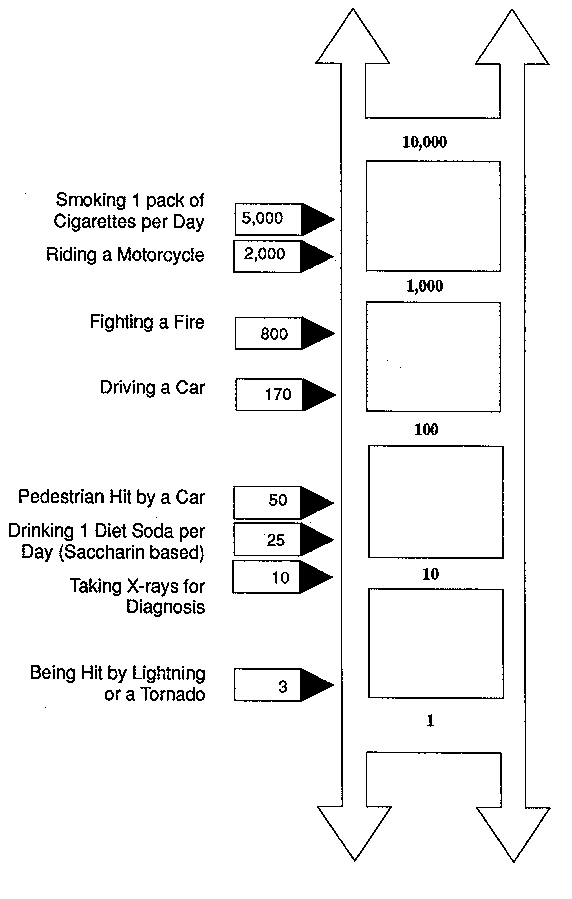
Source: Adapted from Schultz, W., G. McClelland, B. Hurd, and J. Smith (1986), Improving Accuracy and Reducing Costs of Environmental Benefits Assessment, Vol. IV. Boulder: University of Colorado, Center for Economic Analysis.
Warning!
Use of data in this table for risk comparison purposes can damage your credibility (see text).Figure B.2
Upper Bound Estimates of Deaths
for Different Energy Systems
Source: Adapted from Inhaber, H. (1979), “Risks with energy from conventional and non-conventional sources.” Science, 203, 1979, 718–723. Also Inhaber, H., Risk of Energy Production, Report No. AECB 119/rev. 3, 4th edition. Ottawa: Atomic Energy Control Board, 1979.
Figure B.3
Comparisons of Different Sources
of Radiation Exposure
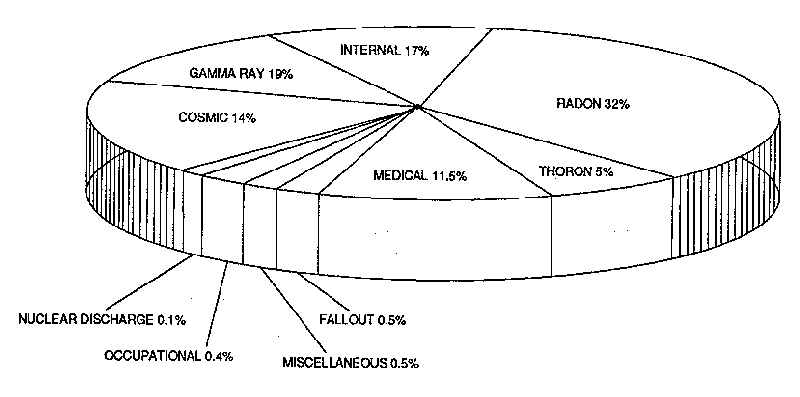
Source: Adapted from the National Radiological Protection Board (1986), Living with Radiation, London: HMSO.
Warning!
Use of data in this table for risk comparison purposes can damage your credibility (see text).Figure B.4
The Causes of Cancer:
Quantitative Estimates of the
Avoidable Risk of Cancer in the U.S.
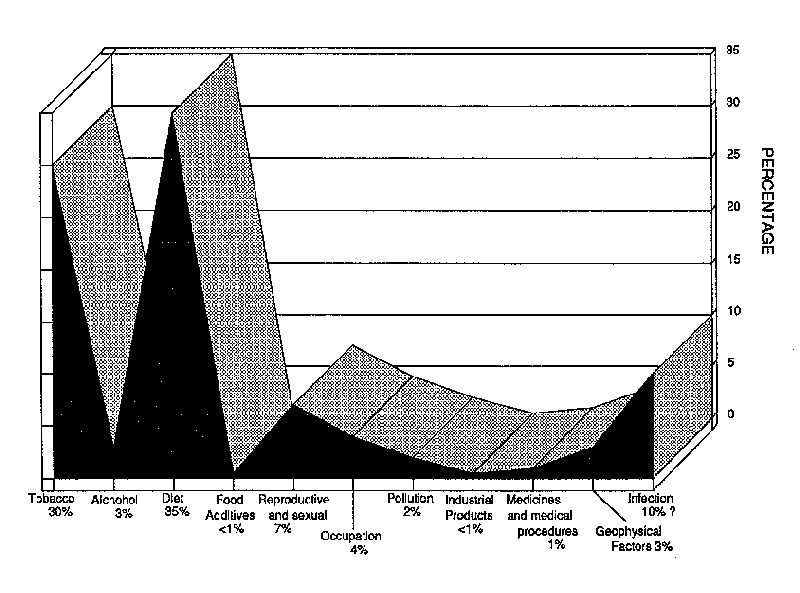
Note: Due to rounding error, percentage figures do not add up to one hundred percent.
Source: Adapted from Doll, R. and Peto, R. (1981), “The Causes of Cancer: Quantitative Estimates of the Avoidable Risk of Cancer in the U.S. Today.” Journal of the National Cancer Institute, 1981, Vol. 66, 1191–1308.
Warning!
Use of data in this table for risk comparison purposes can damage your credibility (see text).Figure B.5
Radon Risk Charts
Source: Adapted from Smith, V.K., W.D. Desvousges, and A. Fisher (1987), Communicating Radon Risk Effectively: A Mid-Course Evaluation, Report No. CR–811075. Washington, D.C.: U.S. Environmental Protection Agency, Office of Policy Analysis.
Copyright © 1988 by Chemical Manufacturers Association
Abbreviated Table of Contents
Table of Contents and Introduction
I . Effectively Communicating Risk Information
II. Guidelines for Presenting and Explaining Risk-Related Numbers and Statistics
III. Guidelines for Providing and Explaining Risk Comparisons
IV. Concrete Examples of Risk Comparisons
V. Anticipating Objections to Explanations of Chemical Risks
Appendix A: Concentration and Quantity Comparisons
Appendix B: Risk Comparison Tables And Figures