


This page has two purposes.
- For readers who are new to risk communication, the page will give you a quick introduction to the field and suggest other introductory articles you may want to read first.
- For readers who are familiar with risk communication but new to my approach and my website, the page will orient to you the way I see the field and the way I have organized the site.
The most important fact about risk communication is the incredibly low correlation between a risk’s “hazard” (how much harm it’s likely to do) and its “outrage” (how upset it’s likely to make people). If you know a risk is dangerous, that tells you almost nothing about whether it’s upsetting. If you know it’s upsetting, that tells you almost nothing about whether it’s dangerous.
Based on this distinction, I categorize risk communication into four tasks:
- When hazard is high and outrage is low, the task is “precaution advocacy” – alerting insufficiently upset people to serious risks. “Watch out!”
- When hazard is low and outrage is high, the task is “outrage management” – reassuring excessively upset people about small risks. “Calm down.”
- When hazard is high and outrage is also high, the task is “crisis communication” – helping appropriately upset people cope with serious risks. “We’ll get through this together.”
- When hazard and outrage are both intermediate, you’re in the “sweet spot” (hence the happy face) – dialoguing with interested people about a significant but not urgent risk. “And what do you think?”
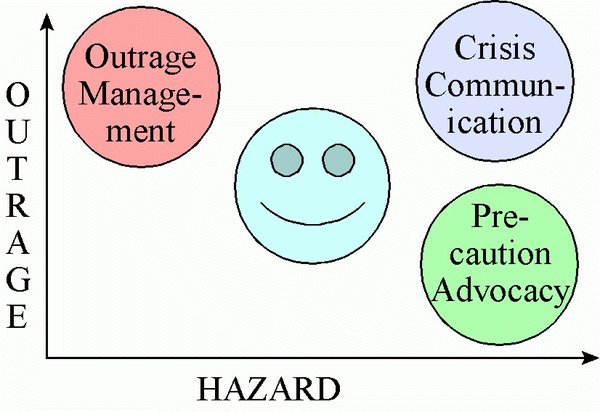
The sweet spot is easy, so I don’t write about it much.
The other three are tough – but they’re tough in different ways. Thus, the strategies and skills required for effective precaution advocacy, outrage management, and crisis communication are also different.
To figure out how to do good risk communication, you must first figure out where you are on the risk communication “map.” How high do you think the hazard is (or is likely to get)? How high do you think the outrage is (or is likely to get)? So which toolkit do you need – precaution advocacy, outrage management, or crisis communication?
I have cherry-picked the writing on this website and identified the columns, articles, and Guestbook entries I think are most helpful in each of these three corners of my risk communication map.
So if you know you’re looking for help arousing concern about a serious hazard, look at the Precaution Advocacy Index.
If you know you’re looking for help reassuring people about a small hazard, look at the Outrage Management Index.
And if you know you’re looking for help guiding justifiably upset people through a serious hazard, look at the Crisis Communication Index.
There’s one more topical index on this website, the Pandemic Flu and Other Infectious Diseases Index. That one cuts across my other categories. Warning people about an infectious disease risk they’re ignoring is precaution advocacy; calming them about an infectious disease risk they’re over-reacting to is outrage management; guiding them through a serious outbreak, epidemic, or pandemic is crisis communication.
A lot of what’s on this website isn’t in any of the four topical indexes. Some pieces don’t quite fit into any of the four. Some I left out because they cover the same ground as others … and not as well. Some (especially in the Guestbook) struck me as too narrow.
If you want to look through everything on the site, you need to check the four complete lists:
Finally, if you want to read some more introductory articles on risk communication and the basics of my “Risk = Hazard + Outrage” approach, try the following.
Topical Sections in Introduction and Orientation
Risk Communication Overviews
-
Communicating Risk: Neglected and Controversial Rules of Thumb
Presented at the Grady College of Journalism and Mass Communication, University of Georgia, Athens GA, October 16, 2013
In October 2013, I spent three days at the University of Georgia’s Grady College of Journalism and Mass Communication. The main agenda was to negotiate a possible “Sandman Archive” of my papers and web materials, an initiative of the new Grady program in health and risk communication. (See “Working Toward a Legacy.”) But while I was there I also gave a number of class presentations and one public presentation, which was videotaped. I offered my hosts a choice of half a dozen presentation topics, and they asked me to combine them all into a potpourri of interesting risk communication pointers. So this video is different from most of the introductory videos I have posted. It’s got a little of everything. There’s a quick summary of “Risk = Hazard + Outrage” and my three paradigms of risk communication (my usual introductory shtick). But there’s also a discussion of why information is rarely life-changing and why cognitive dissonance can make it so; of why it’s important to be willing to speculate and to be willing to scare people; and of the need for public health professionals to tell the whole truth about vaccination. As I said: a potpourri.
-
Risk Communication: Evolution and Revolution
In Solutions to an Environment in Peril, Anthony Wolbarst (ed.) (Baltimore: Johns Hopkins University Press, 2001), pp. 164–178
Back in the 1980s, Vincent Covello and I gave back-to-back presentations on risk communication as part of a U.S. Environmental Protection Agency lecture series. When Tony Wolbarst of EPA decided to collect the presentations into a book, he offered everyone a chance to revise and update. Vincent and I decided to merge our efforts into a single article on the state of risk communication, based loosely on what we had said originally plus what we now consider important. The result is a pretty good overview of the shared opinions of two well-seasoned practitioners.
-
A chapter in Encyclopedia of the Environment, 1994
Being asked to summarize the whole of risk communication in a short encyclopedia article was a challenge (even a decade ago, when much less was known). For me the biggest challenge was to summarize risk communication, not just my approach to it. I think I partially succeeded.

Hazard versus Outrage and
the Four Kinds of Risk Communication
Risk=Hazard+Outrage: Some Risk Communication Basics
Keynote presentation via Zoom for the Australian Institute of Occupational Hygienists, Perth, Western Australia, December 3, 2024
On December 3, 2024, I gave this brief keynote presentation (via Zoom) to the annual conference of the Australian Institute of Occupational Hygienists, meeting in Perth, Western Australia.
I managed to summarize my basic approach to risk communication in 25 minutes or so (with a bit more emphasis on outrage management). Another 23 minutes of Q&A followed.
The videographer stayed mostly on me in front of a blank screen, with occasional shots of the audience. The audience could see my slides but they’re not on the video. A clock to help me keep to my time limit is on the video.
This is worth posting mostly because it’s short and recent. Except for the Q&A, there’s nothing new here.
 Link to the offsite Zoom file on Vimeo (48 min.)
 Link launches an on-site audio file of the presentation (64.5MB, 46.58 min.)
 Link launches an onsite file with the PowerPoint slides (141 kB)
Risk=Hazard+Outrage: Some Risk Communication Basics (and some COVID comments) – 2024 Edition
Class presented via Zoom to Prof. Michael Osterholm’s course on “Emerging Infectious Diseases: Current Issues, Policies and Controversies,” University of Minnesota School of Public Health, February 5, 2024
Prof. Mike Osterholm of the University of Minnesota Center for Infectious Disease Research and Policy periodically asks me to give a Zoom class on risk communication for his School of Public Health graduate course on “Emerging Infectious Diseases.” I previously posted the March 21, 2022 “edition.” You can access the video, audio, and slide set there.
This is the February 5, 2024 edition. The main difference is this time I got permission to include an audio of the 83-minute Q&A that followed my presentation. This Q&A pretty much ignored my hazard-versus-outrage basics and focused on what went wrong in COVID risk communication. The class reading assignment had included two of my pre-COVID articles on public health dishonesty (here and here), so there was discussion of that topic too. I recorded the Q&A on my phone, so my answers are clear but the students’ questions are barely audible.
Another difference: This time I'm also posting Zoom’s machine transcript of the presentation, for those who’d rather read than watch or listen.
The content of the Q&A is new, of course, but the presentation itself is mostly my trademark explanation of the distinction between hazard and outrage and the resulting paradigms of risk communication: precaution advocacy, outrage management, crisis communication, and public participation. Along the way and at the very end I commented on COVID implications of the various paradigms … a little of which did change between 2022 and 2024.
Link to the offsite Zoom file on Vimeo (66 min.)
Link launches an on-site audio file of the presentation (92MB, 66 min.)
Link launches an onsite file with the PowerPoint slides (229 kB)
 Link to an on-site file with a machine transcript of the presentation (60kB)
Link launches an on-site audio file (71MB, 81min.) of the Q&A following the presentation
Looking Back: Tracing How I Got to My Approach to Risk Communication
Interview via Zoom with Margaret Harvie and Lewis Michaelson, April 27, 2023
In early March 2023, Australian friend and colleague Margaret Harvie asked me to sit for a Zoom interview on the history of my approach to risk communication. She said she and Lewis Michaelson were doing a series of such interviews for the International Association for Public Participation (IAP2) with “creators of some of the IAP2 products,” focusing on “what was happening at the time that led to [their] thinking.” The result was a 66-minute three-way April 27 interview, a chance for me to talk my way through how I got into risk communication, how I came up with “Hazard versus Outrage,” how I think outrage management relates to public participation, and related topics. I also spent some time at the end outlining some of the ways risk communication can be subdivided: precaution advocacy versus outrage management versus crisis communication versus “the sweet spot”; education versus persuasion; stakeholder relations versus public relations versus government relations etc.; and support mobilization versus public relations versus outrage management.
Link to the offsite Zoom file on Vimeo (66 min.)
Link launches an on-site audio file (90MB, 66 min.)
Link to a page with a 20-minute video edit (and interviews with other IAP2 “pioneers”)
Risk=Hazard+Outrage: Some Risk Communication Basics (and some COVID and H5N1 comments)
Class presented via Zoom to Prof. Michael Osterholm’s course on “Emerging Infectious Diseases: Current Issues, Policies and Controversies,” University of Minnesota School of Public Health, February 10, 2025.
I give this lecture annually to Mike Osterholm’s University of Minnesota graduate course on emerging infectious diseases. This year’s iteration took place via Zoom on February 10, 2025. It’s mostly my standard shtick on the basics of my approach to risk communication – minus the Q&A at the end, which some students didn’t want recorded.
What’s new? Some comments at the start on public health dishonesty and on how public health professionals might best respond to the challenges of the Trump presidency; and some comments interspersed throughout on the possibility of an H5N1 (bird flu) pandemic.
Link to the offsite Zoom file on Vimeo (64.1 min.)
Link launches an on-site audio file of the presentation (85.3MB, 62 min.)
Link launches an onsite file with the PowerPoint slides (229 kB)
Risk = Hazard + Outrage: Some Risk Communication Basics (and some COVID comments)
Class presented via Zoom to Prof. Michael Osterholm’s course on “Emerging Infectious Diseases: Current Issues, Policies and Controversies,” University of Minnesota School of Public Health, March 21, 2022.
Michael Osterholm of the University of Minnesota Center for Infectious Disease Research and Policy periodically asks me to give a Zoom class on risk communication for his School of Public Health course on emerging infectious diseases. The most recent one on March 21, 2022 was recorded (except for the wonderful Q&A) – so here it is.
It’s mostly my trademark presentation on the distinction between hazard and outrage and the resulting paradigms of risk communication: precaution advocacy, outrage management, crisis communication, and public participation (stakeholder consultation). Along the way and at the very end I commented briefly on COVID risk communication.
Link to the offsite Zoom file on Vimeo (56 min.)
Link launches an on-site audio file (55.6MB, 56 min.)
Link launches an onsite file with the PowerPoint slides (229 kB)
Risk = Hazard + Outrage: Three Paradigms of (Radiation) Risk Communication
Webinar presented via Zoom to the “Web Symposium on Risk Communication in Radiation Disaster,” Fukushima Medical University, February 7, 2022 (presentation prerecorded on December 16, 2021)
This is my basic introduction to risk communication, focusing on the distinction between hazard and outrage and the three paradigms of risk communication resulting from that distinction – plus a fourth paradigm, stakeholder consultation when hazard and outrage are both intermediate. The occasional references to radiation-specific issues are brief, as is the Q&A at the end. I do like the slides on radiation-related uses for each paradigm. Also, the video is higher-quality technically than the other Zoom videos I have posted. Since the symposium sponsor has posted the video on YouTube, I’m linking to it there instead of uploading it to Vimeo as usual.

Risk = Hazard + Outrage: Three Paradigms of (Wildfire) Risk Communication
Webinar presented via Zoom, hosted by the European Forest Institute, November 15, 2021
In July 2021, the European Forest Institute started putting together a risk communication course, to be offered in November for wildfire management doctoral students throughout Europe (and a few from elsewhere). I agreed to give the November 15 keynote (via Zoom). At EFI’s request, I kept the keynote generic. Applying my principles to wildfire risk communication challenges would be the students’ task, I was told, not mine. So only the last minute or two of my 45-minute presentation has anything to do with wildfires, plus the 25-minute Q&A that followed.
The presentation itself focuses on the hazard-versus-outrage distinction and the three risk communication paradigms that follow from that distinction – plus a fourth paradigm I don’t always talk about, public consultation when both hazard and outrage are intermediate. I didn’t break any new ground here, but this is a pretty good, pretty short introduction to the basics of my approach. And I think the 25-minute Q&A is excellent.
Pesticide Outrage Management – Part 1
Webinar presented via Zoom to the Region One Pesticide Inspector Regional Training (PIRT) program of the U.S. Environmental Protection Agency, February 23, 2021
I came out of retirement in January 2020 to try to help with the COVID pandemic. I wasn’t interested in any other work. But in early 2021, I was asked to do a two-hour Zoom training seminar for pesticide managers on how to cope with pesticide safety controversies. I thought it would be a nice change of pace from the pandemic, so I said yes.
This is Part 1, 56 minutes long, devoted mostly to the basics of risk communication: the distinction between hazard and outrage and the three paradigms of risk communication resulting from that distinction. Toward the end I focus on the paradigm most relevant to pesticide controversies, outrage management – beginning with some thoughts on how to stay empathetic in high-stress situations. Part 2 (65 minutes) is listed here, including more on outrage management and some Q&A on pesticide outrage management in particular.
The training was sponsored by the Region One Pesticide Inspector Regional Training (PIRT) program of the U.S. Environmental Protection Agency. It was organized and hosted by the Pesticide Management Program of the Connecticut Department of Energy and Environmental Protection.
Three Paradigms of Risk Communication – and a critique of COVID-19 Crisis Communication
Webinar presented via Zoom, then posted on YouTube, hosted by the Institute for Risk and Uncertainty, University of Liverpool, July 7, 2021
In April 2021, the University of Liverpool Institute for Risk and Uncertainty asked me to give a presentation in its monthly webinar series. We agreed I would divide my time between my “signature risk communication formula” and my criticisms of the way COVID-19 has been communicated. And on July 7 that’s what I did. The first third of this 94-minute webinar is introductory, my “Risk = Hazard + Outrage” formula and the three risk communication paradigms I derive from the formula. The second third is my critique of COVID-19 crisis communication, mostly in the U.S. The final third is Q&A and discussion, much of it focusing on COVID-19 risk communication dilemmas in the U.K.
My hosts promptly posted the webinar on YouTube, as they always do. That link is below. Also below is an audio-only recording of the webinar and my slide set, so you’re free to follow along on your own if you prefer.

Peter Sandman: How Your Ability To Process Risk Can Save Your Life
Interview with Chris Martenson of Peak Prosperity, podcast posted July 7, 2020
Chris Martenson’s “Peak Prosperity” YouTube channel currently claims 368,000 subscribers. Chris is best known for his “Crash Course” on how pretty much everything is in rapid decline. In 2020, not surprisingly, he has posted dozens of videos on COVID-19. One of these, posted in March, was devoted entirely to my 2005 article on the adjustment reaction concept. Entitled “Coronavirus: How To Inform Your Friends & Family Without Creating Pushback,” it got 330,000 views and 4,428 comments in three months – way out of my league.
So when Chris said he wanted to interview me via Zoom for an hour-long podcast, I said yes. We did it on June 29. Chris wanted to talk (again!) about adjustment reactions. I wanted to talk (again) about the basics of risk communication. We both wanted to talk about the ways the U.S. is mismanaging the COVID-19 pandemic. So we did all three. Our COVID-19 discussion focused mostly on a risk communication analysis, but we inevitably veered into risk management and epidemiology as well.

Presented to the New South Wales Environment Protection Authority, Sydney Australia, February 2, 2016
This three-hour video (and audio) is the entire first morning of a 1-1/2-day risk communication seminar I presented in February 2016 for the New South Wales Environment Protection Authority. GHD, an Australia-based engineering and environmental consulting firm, brought me to Australia for this and other events.
The video covers the same ground as the first half-day of my September 2010 risk communication seminar for the Rio Tinto mining company. There are differences, but they’re very minor given that a half-decade had passed and this time I was talking to a regulatory agency instead of a mining company. Watch whichever one you prefer.
Other environmental regulators from throughout Australia were also invited to attend the EPA seminar, courtesy of the Australasian Environmental Law Enforcement and Regulators Network (AELERT), which videotaped the first morning. AELERT also made three edited segments based on the raw footage. Two are available in video and audio, and one just in audio. Choose either the unedited tape (inaudible questions and all) or the three edited segments. (There is no edited segment covering the last part of the morning on the three risk communication “games.”)
Aired on Australian Broadcasting Corporation’s “Media Report” radio program and posted on its website, August 28, 2014
(Complete) Interview with Peter Sandman by Richard Aedy, August 11, 2014
Richard Aedy interviewed me for Australian radio via telephone for 20 minutes on August 11. The edited 11:40 interview aired on August 28, a few days before I started a speaking and consulting tour of Australia. There’s nothing special about this interview, except the fact that it’s recent and short. We covered the usual basics: the hazard-versus-outrage distinction, the three paradigms of risk communication, etc. Like many media interviewers, Richard was especially interested in whether risk communication is really just a different label for “spin,” and in what I think about the performance of the media. (In fairness, he asked about social media as well as mainstream media.) As always, I prefer the longer or more idiosyncratic interviews. But this one is a sensible quick orientation.
Terrorists vs. Bathtubs
(Note: Link goes off-site to a page with a link to this 10-min. audio.)
Aired on National Public Radio’s “On the Media” and posted on its website, June 21, 2013
 Risk Communication in Practice(Note: Link launches an MP3 audio file on this site: 79.5MB, 49 min.)
(Complete) interview with Peter Sandman by Brooke Gladstone, June 20, 2013
Brooke Gladstone of “On the Media” interviewed me in my home for 49 minutes. We started out talking about claims by opponents of NSA telephone and email surveillance (in the wake of the Edward Snowden leaks) that “more people have died from [whatever] than from terrorism” – and why these sorts of risk comparisons are unlikely to be convincing. That soon got me to the distinction between hazard and outrage. But Brooke didn’t let me do my usual hazard-versus-outrage introductory shtick. Instead, she kept asking for specifics – examples of how precaution advocacy and outrage management strategies work in practice. Toward the end of the interview, she pushed me to shoot from the hip about applications I hadn’t thought through: How would I use risk communication to defend government surveillance? To oppose it? To defend shale gas “fracking”? To oppose that? The interview that resulted is a different sort of introduction to risk communication than the one I usually give. The 10-minute broadcast segment is nicely edited; it’s very smooth and covers most of my main points. But I prefer the roughness and detail of the complete interview.
Atomic Show #205 – Peter Sandman teaches nuclear communicators (Note: Link goes off-site to a page with this 102-min. audio)
Podcast for the “Atomic Insights” website, May 31, 2013 (with Rod Adams, Margaret Harding, Meredith Angwin, and Suzy Hobbs-Baker)
Rod Adams runs a website called “Atomic Insights” that promotes nuclear power. In early May 2013 he discovered my approach to outrage management, and put posts on his own website and on an American Nuclear Society website urging nuclear power proponents to learn outrage management. The responses to his two posts led Rod to invite me to do this podcast.
The podcast itself runs 1 hour and 42 minutes. Most of it is a basic introduction to risk communication and then to outrage management: the hazard-versus-outrage distinction, the components of outrage, the three paradigms of risk communication, the key strategies of outrage management, etc. But I did try to focus especially on what the nuclear power industry and its supporters get wrong – for example, imagining that their core communication mistake is failing to sell their strengths effectively, whereas I believe it is failing to acknowledge their problems candidly. There are recommendations for nuclear communication throughout the podcast, and a Q&A at the end with Rod and fellow proponents Margaret Harding, Meredith Angwin, and Suzy Hobbs-Baker. The plan is to follow up with a second podcast, a more narrowly focused roundtable discussion among the five of us on nuclear power outrage management.
Posted: May 7, 2011
This ten-minute audio clip distinguishes the terms “risk communication,” “risk assessment,” and “crisis communication”; describes the fundamental risk communication distinction between hazard and outrage; and uses that distinction to define the three paradigms of risk communication. It ends with a discussion of how to measure outrage. This is one of four podcasts on “Risk Communication in Healthcare Settings,“ aimed at healthcare managers, produced from a 50-minute telephone interview.
Posted: May 7, 2011
This nine-minute audio clip discusses some key strategies associated with each of the three paradigms of risk communication: precaution advocacy (high hazard, low outrage), outrage management (low hazard, high outrage), and crisis communication (high hazard, high outrage). It emphasizes the need to assess – and continually reassess – which paradigm is called for by the specific communication environment you face. This is one of four podcasts on “Risk Communication in Healthcare Settings,“ aimed at healthcare managers, produced from a 50-minute telephone interview.
The Law of Conservation of Outrage: Outrage Is Limited – Do You Need More or Less?
Posted: April 14, 2011
I speak and write endlessly about ways to increase people’s outrage when you think they’re insufficiently upset about a serious risk and ways to decrease their outrage when you think they’re excessively upset about a not-so-serious risk. I call these two kinds of risk communication “precaution advocacy” and “outrage management” respectively. This column makes a point I too often forget to mention: Except in emergencies (real or imagined), it’s impossible to get people more or less outraged. Mostly what we do is reallocate their outrage. The column calls this “the Law of Conservation of Outrage,” and discusses six corollaries that are fundamental to risk communication: the natural state of humankind vis-à-vis any specific risk is apathy; outrage is a competition; there’s no reason to worry about turning people into scaredy-cats; if people are more outraged at you than the situation justifies, you’re doing something wrong; excessive outrage aimed at you isn’t your critics’ fault; and outrage causes hazard perception – and we know what causes outrage.
Risk = Hazard + Outrage
Presented to the Rio Tinto mining company, Brisbane, Australia, September 16–17, 2010
Posted: January 12, 2011
This video clip outlines the fundamental distinction between a risk’s “hazard” (how much harm it’s likely to do) and its “outrage” (how upset it’s likely to make people). The selection emphasizes that both hazard perception and hazard response result more from outrage than from hazard.
Two short excerpts from this clip have been posted on YouTube (more or less as advertisements for the clip, and the course as a whole):
Components of Outrage and a Sample Outrage Assessment
Presented to the Rio Tinto mining company, Brisbane, Australia, September 16–17, 2010
Posted: January 12, 2011
This video clip runs through the twelve principal components of outrage (voluntary versus coerced, natural versus industrial, etc). Then it illustrates these components with a seat-of-the-pants “outrage assessment” of genetically modified food.
Three Paradigms of Risk Communication
Presented to the Rio Tinto mining company, Brisbane, Australia, September 16–17, 2010
Posted: January 12, 2011
This video clip outlines the three main paradigms of risk communication: precaution advocacy (when hazard is high and outrage is low); outrage management (when hazard is low and outrage is high); and crisis communication (when hazard and outrage are both high).
Three Paradigms of Radiological Risk Communication: Alerting, Reassuring, Guiding
Presented to the National Public Health Information Coalition, Miami Beach FL, October 21, 2009
Posted: January 2, 2010
Although this six-hour seminar was entitled “Three Paradigms of Radiological Risk Communication,” NPHIC asked me to go easy on the “radiological” part and give participants a broad introduction to my approach to risk communication, mentioning radiation issues from time to time. So that’s what I did.
Fair warning: These are not professional videos. NPHIC member Joe Rebele put a camera in the back of the room and let it run. You won’t lose much listening to the MP3 audio files on this site instead.
- Part 1
-
Part One is a introduction to the hazard-versus-outrage distinction and the three paradigms of risk communication.
- Part Two
-
Part Two discusses the seesaw and other risk communication games (thus completing the introductory segment), then spends a little over an hour each on some key strategies of precaution advocacy and outrage management.
- Part Three
-
Part Three is a rundown on some key crisis communication strategies.
See especially Part One.
-
Food Safety Risk Communications
(Note: This link launches an MP3 audio file from this site.)Presented at the Maple Leaf Food Safety Symposium, Mississauga Canada, October 23, 2009
In August 2008, Listeria contamination in Maple Leaf packaged deli meats killed 21 elderly consumers, one of the largest food poisoning disasters in Canadian history. As one small part of its recovery efforts, Maple Leaf Foods sponsored a food safety symposium in October 2009, bringing together producers, retailers, and regulators to talk about lessons learned and ways to protect against Listeria. My presentation on “Food Safety Risk Communication” was inserted as respite from the technical material in most of the other speeches. I did my usual introduction to hazard versus outrage and the kinds of risk communication, and then offered a few food-specific examples (until I ran out of time). Audience comments and questions weren’t recorded; that’s what the occasional moments of dead air are.
-
Fundamentals of risk communication: How to talk to patients and the public about pandemic H1N1
Presented to the European Respiratory Society international conference, Vienna, Austria, September 14, 2009
The European Respiratory Society invited me give a 20-minute presentation on pandemic communication at its annual conference, as part of a panel on various aspects of pandemic H1N1. I pleaded for an extra hour right afterwards to go into more detail for those who wanted it. Some 20,000 respiratory disease doctors attended the conference; roughly 2,000 of them were at the panel; about 200 followed me to a smaller room for my extra hour (which I did jointly with my wife and colleague Jody Lanard, an M.D.). Only the panel presentation is posted on the ERS website. It’s mostly an introduction to the basics of risk communication (hazard versus outrage; precaution advocacy versus outrage management versus crisis communication), with some quick comments on the implications for pandemic communication. The meat was in the hour that followed, which unfortunately wasn’t recorded.
Interview with Dr. Peter Sandman
Posted on the National Public Relations website, March 9, 2009
Canadian PR firm National Public Relations was one of the sponsors that brought me to Vancouver in March 2009 to give a two-day risk communication seminar (jointly with my wife and colleague Jody Lanard), organized by the University of British Columbia. As part of the event, the company taped this seven-minute interview with me on the basics of my “Risk = Hazard + Outrage” formula. The tape was posted (and labeled a “podcast”) on the National Public Relations website, and the link was emailed to conference participants and National Public Relations clients. It’s no longer on the National Public Relations site, so I have posted it here. If you prefer listening to reading, this is an okay introduction.
-
Managing Outrage and Crises: Dealing with Risk by Understanding Your Audience

Published in Food Technology News (Guelph Food Technology Centre), June 2007
Over the past year I have given a presentation and a seminar at the Guelph Food Technology Centre in Guelph, Ontario. This article by Cliona Reeves is adapted from bits and pieces of the two. It focuses on the distinction among precaution advocacy (high-hazard, low-outrage), outrage management (low-hazard, high-outrage), and crisis communication (high-hazard, high-outrage). I have written about this distinction myself, particularly in “Four Kinds of Risk Communication.” But this article adds value in that it’s a little more detailed, a little more current, and particularly focused on food examples. The “quotations” in the article are actually mostly paraphrases, but Cliona checked with me before publication and they do capture my meaning, if not always my exact words.
-
How much risk do you live with?
Published in the Vancouver Sun, March 9, 2007
Once a month or so I get interviewed for a newspaper article on risk perception. The articles all cover the same ground: “The scary risks aren’t necessarily the ones that kill you. Here are some stunning examples. And here’s why the experts say we’re so foolish.” I don’t usually bother to post these articles. But this one struck me as unusually well done. It also focuses a lot on a hypothesis that most such articles ignore: risk homeostasis – the notion that people want as much risk in their lives as they want, and therefore compensate for safety improvements by taking more risks. On the other hand, this article – like most – steadfastly ignores a point I made to the reporter (as I always do): It isn’t really foolish to consider “outrage factors” like voluntariness, morality, and trust relevant to how acceptable a risk is; it isn’t really sensible to ignore these factors and focus exclusively on mortality statistics.
-
Risk Perception, Risk Communication, and Risk Reporting: The Role of Each in Pandemic Preparedness
Originally presented at a conference on “Avian Flu, a Pandemic & the Role of Journalists,” Nieman Foundation for Journalism, Harvard University, Cambridge MA, December 1, 2006
An abridged version
of this presentation was published in the Spring 2007 issue of Nieman Reports. This version is the original transcript, made available to me by the Nieman Foundation for Journalism. I edited it very lightly so it makes sense – but it’s still very much a transcript, not a polished article. Despite the title, the transcript is a pretty good orientation to risk communication the way I see it.

-
Four Kinds of Risk Communication
Posted: April 11, 2003
This short column was an early attempt to lay out what I see as the four kinds of risk communication. Some of my labels have changed since 2003. When hazard is high and outrage is low, the job is warning apathetic people about serious risks. I now call that precaution advocacy; the column called it public relations. When hazard is low and outrage is high, the job is calming upset people about small risks. I called that outrage management in the column, and that’s still what I call it. When hazard and outrage are both high, the job is helping rightly upset people bear a dangerous situation. No change in that label either; it’s crisis communication. Finally, when hazard and outrage are both intermediate, the job is chatting with interested people about a real but not urgent risk. The column called that stakeholder relations; I now call it “the sweet spot.”
Spanish translation available
-
Agency Communication, Community Outrage, and Perception of Risk: Three Simulation Experiments
Risk Analysis, Vol 13, No. 6, 1993, pp. 585–598
My conviction that the “outrage” component of risk influences public responses more than its “hazard” component is grounded in two decades of consulting experience ... and a scant handful of empirical research studies. This article reports most of the latter.
-
Risk Communication: Facing Public Outrage
EPA Journal (U.S. Environmental Protection Agency), November 1987, pp. 21–22
This is one of the earliest – and the shortest and most often cited – of my articles about the distinction between hazard and outrage. The focus is on the factors that determine whether people will over-react or under-react to a risk.
Spanish translation available
Traducción en Español: Comunicación de riesgos: afrontar el ultraje público

The Seesaw and the Other Risk Communication Games
-
Three Risk Communication “Games”
Presented to the Rio Tinto mining company, Brisbane, Australia, September 16–17, 2010
Posted: January 12, 2011This video clip (length: 28:48) describes three risk communication “games”: follow-the-leader (when you’re talking to an audience with no prior opinion); donkey (when you’re talking to an audience whose prior opinion you’re trying to change); and above all seesaw (when your audience is ambivalent, torn between the opinion you’re championing and an opposing opinion).
-
Three Paradigms of Radiological Risk Communication: Alerting, Reassuring, Guiding
Presented to the National Public Health Information Coalition, Miami Beach FL, October 21, 2009
Posted: January 2, 2010Although this six-hour seminar was entitled “Three Paradigms of Radiological Risk Communication,” NPHIC asked me to go easy on the “radiological” part and give participants a broad introduction to my approach to risk communication, mentioning radiation issues from time to time. So that’s what I did.
Fair warning: These are not professional videos. NPHIC member Joe Rebele put a camera in the back of the room and let it run. You won’t lose much listening to the MP3 audio files on this site instead.
- Part 1
-
Part One is a introduction to the hazard-versus-outrage distinction and the three paradigms of risk communication.
- Part Two
-
Part Two discusses the seesaw and other risk communication games (thus completing the introductory segment), then spends a little over an hour each on some key strategies of precaution advocacy and outrage management.
- Part Three
-
Part Three is a rundown on some key crisis communication strategies.
See especially Part Two.

-
Games Risk Communicators Play: Follow-the-Leader, Echo, Donkey, and Seesaw
Posted: December 13, 2005
This short column considers the four possibilities when you are trying to convince me of X: I could have no prior opinion about X; I could believe X already; I could believe Y instead; or I could be ambivalent, torn between X and Y. Each of these four situations has its own risk communication game, described in the column: follow-the-leader, echo, donkey, and seesaw. Good risk communicators need to master all four games. And they need to know how to decide which game they’re playing – or, if they’re playing several at once, which game is most crucial to their communication goals.
-
Advice for President Bartlet: Riding the Seesaw
Posted: July 14, 2001
Readers who were never fans of the “West Wing” television series may not remember when U.S. President Jed Bartlet finally decided to come clean about his multiple sclerosis. The tough question: How to address his desire to run for reelection, despite his illness and despite his having kept it secret. I used this setup as an excuse to write a column about a crucial risk communication strategy for coping with audience ambivalence: the seesaw. When people are ambivalent about X versus Y – for example, when they approve of your presidency and want you back for a second term, but worry that your MS and your dishonesty about it might disqualify you – they tend to go to the side of their ambivalence that is neglected elsewhere in their communication environment. The column outlines the various locations on the seesaw a risk communicator can decide to occupy, and the pros and cons of each. It offers plenty of nonfictional examples as well.
Copyright © 2020 by Peter M. Sandman


 Peter M. Sandman
Website design and management provided by SnowTao Editing Services.